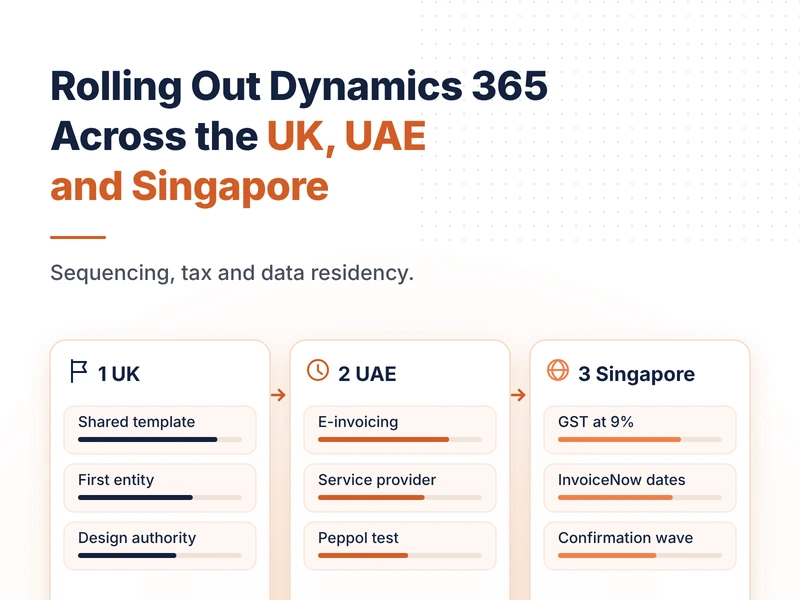
Consider a UK-headquartered group that has approved a global Dynamics 365 Finance template. Four months into design, the UAE finance lead asks which provider will transmit invoices from 1 January 2027, and the Singapore team asks whether its data can sit in a UK-hosted environment. Neither question was in the plan, and both change the go-live order.
A Dynamics 365 rollout across the UK, UAE and Singapore rarely stalls because of the software. It stalls when the sequence follows internal convenience while tax authorities and residency rules run on their own calendars.
Let the regulatory calendar set the sequence
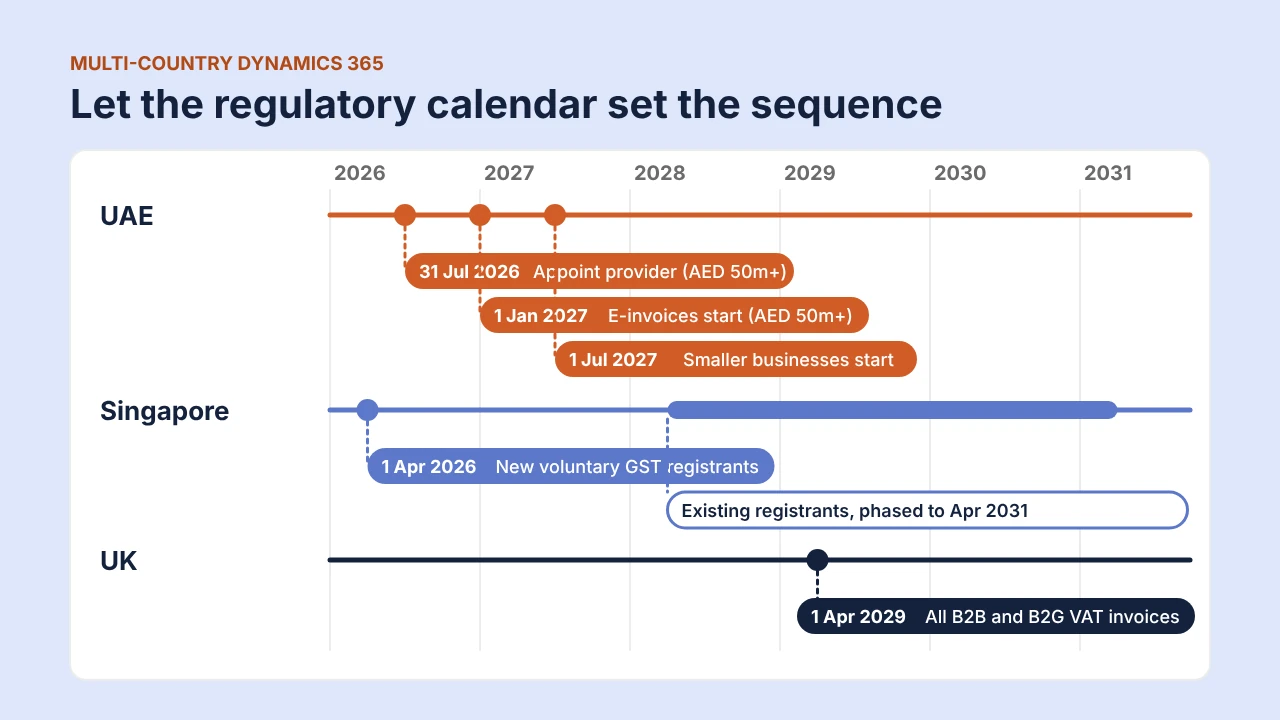
All three countries are moving to structured e-invoicing built on Peppol, on different timelines.
- UAE: Under Ministerial Decision 244 of 2025, businesses with revenue of AED 50 million or more appoint an accredited service provider by 31 July 2026 and issue e-invoices from 1 January 2027. Smaller businesses appoint by 31 March 2027 and start on 1 July 2027. Guidelines are still being revised, and version 2.0 appeared in October 2026.
- Singapore: GST InvoiceNow applies to new voluntary GST registrants from 1 April 2026. Existing registrants follow in phases between April 2028 and April 2031, and IRAS notifies each business of its date.
- UK: All VAT invoices in B2B and B2G transactions must be e-invoices from 1 April 2029. HMRC published its roadmap at Budget 2026, with legislation planned in Finance Bill 2026-27.
The UAE has the shortest runway and the UK the longest. That does not mean the UAE goes live first. It means UAE tax design must be settled early.
A sequence that holds up in practice
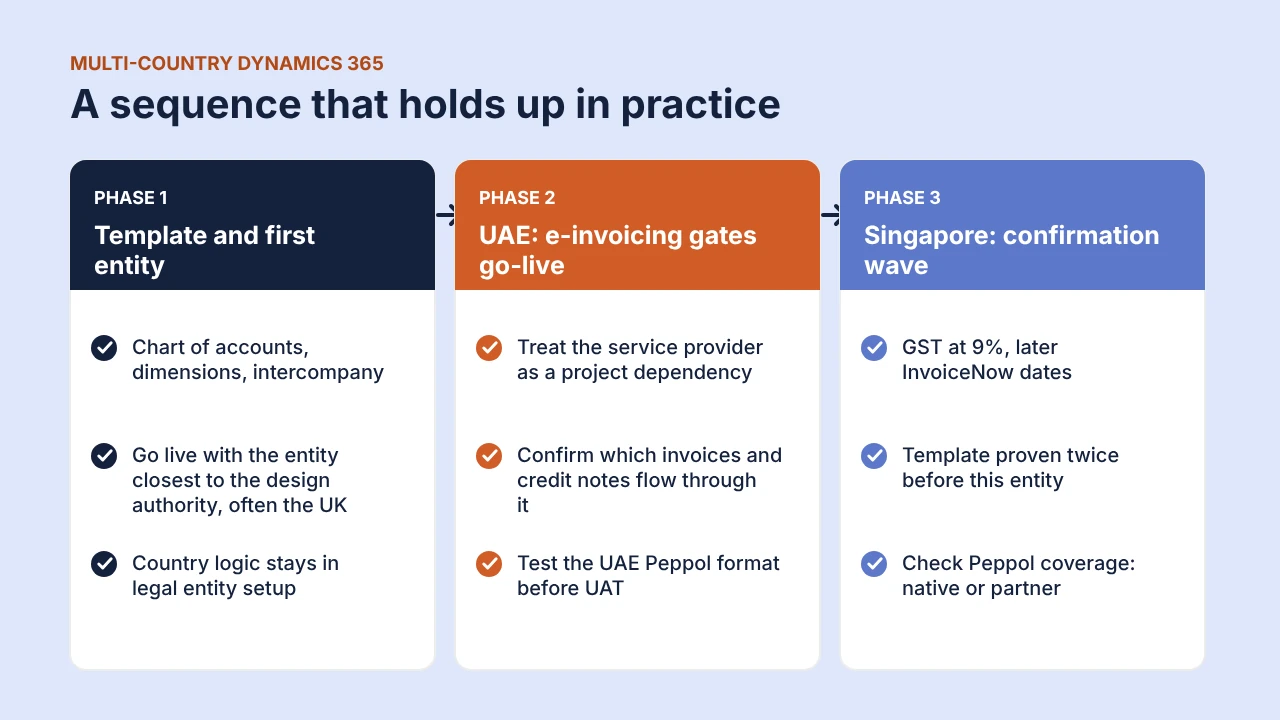
Phase 1: Template and first entity
Build the shared design first: chart of accounts, financial dimensions, intercompany rules, master data standards and security roles. Go live with the entity closest to the design authority, often the UK, so template defects surface while the stakes are manageable. Keep country logic in legal entity configuration, not in the template.
Phase 2: UAE, with e-invoicing as a gating item
Treat the service provider as a project dependency, not a late integration task. Appoint the provider, confirm which invoices and credit notes must flow through it, and test the UAE Peppol format before user acceptance testing. Microsoft has announced Peppol-based e-invoicing for Finance and Operations in the UAE, so confirm availability for your version, along with the add-in, Azure Key Vault and Blob Storage requirements.
Phase 3: Singapore
With GST at 9% and later InvoiceNow dates for existing registrants, Singapore can follow once the template has proven itself twice. Check whether the Singapore Peppol format is covered natively by the Electronic invoicing service or needs a partner solution. Microsoft publishes coverage by country.
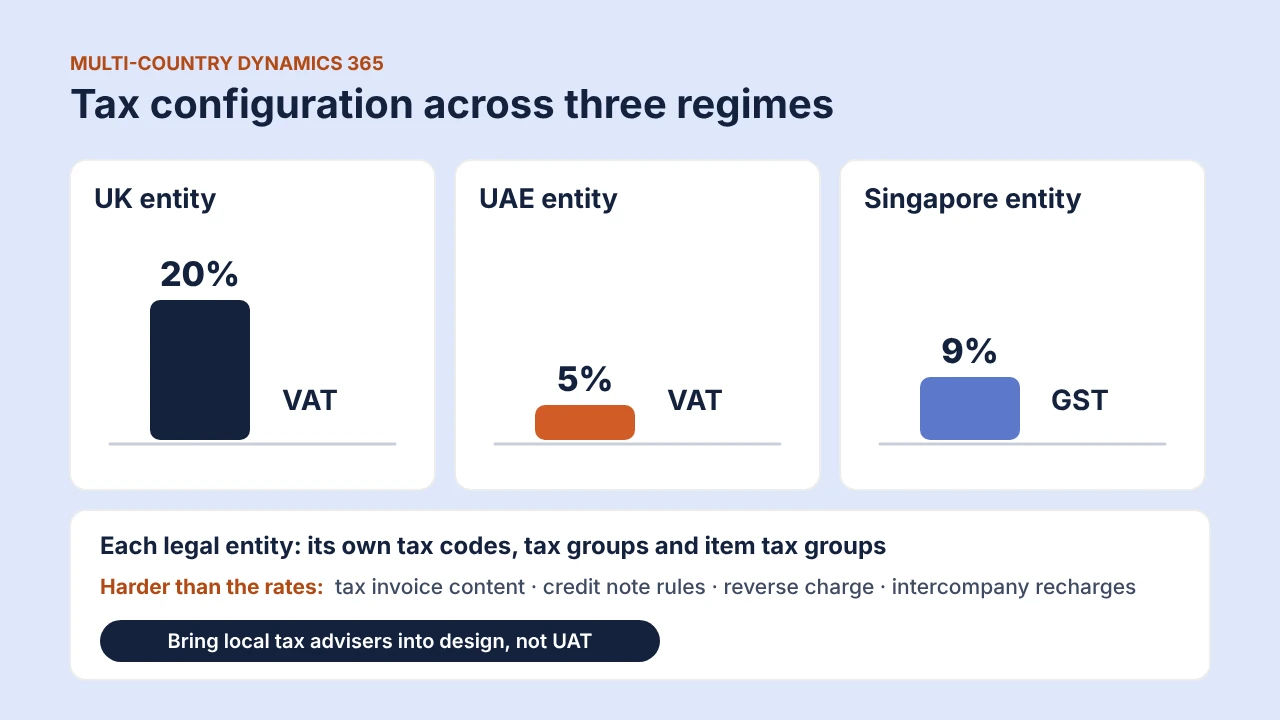
Tax configuration across three regimes
Each legal entity needs its own sales tax setup, covering tax codes, tax groups and item tax groups, with Electronic reporting handling formats. Standard rates are the easy part (UK VAT 20%, UAE VAT 5%, Singapore GST 9%). The harder differences are tax invoice content, credit note rules, reverse charge on imported services and the tax effect of intercompany recharges. A management fee from the UK to the Singapore entity, for instance, raises GST and transfer pricing questions that a global template cannot answer alone. Bring local tax advisers into design, not into user acceptance testing.
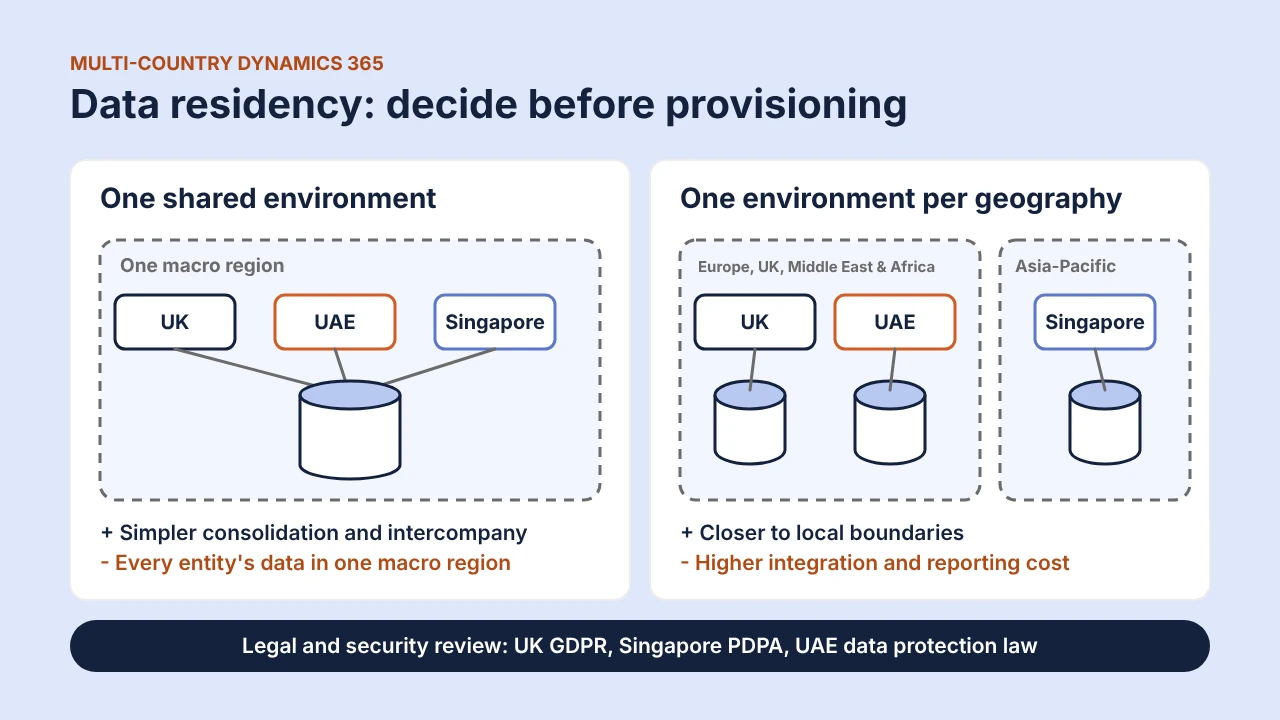
Data residency: decide before provisioning
Finance and Operations environments are deployed to a chosen geography, and Microsoft documents which regions are data resident. Microsoft now describes residency through macro regions: the UK and UAE sit in Europe, UK, Middle East and Africa, and Singapore sits in Asia-Pacific. Customers with Finance or Supply Chain Management and 20 or more paid licences can select a specific region at environment creation. New customers also cannot create Lifecycle Services projects since February 2026, so environments are managed through the Power Platform admin center.
The real decision is one shared environment or one per geography. A shared environment simplifies consolidation and intercompany processing but places every entity's data in one macro region. Separate environments respect local boundaries more closely, at higher integration and reporting cost. Legal and security teams should review the choice against UK GDPR, Singapore's PDPA, UAE data protection law and any sector rules before the architecture is fixed.
Align the Electronic invoicing service with the environment, since it can be deployed in UK, Asia and UAE Azure geographies. Geo-to-geo migration exists, but features missing in the target geography stop working after the move, so check parity first.
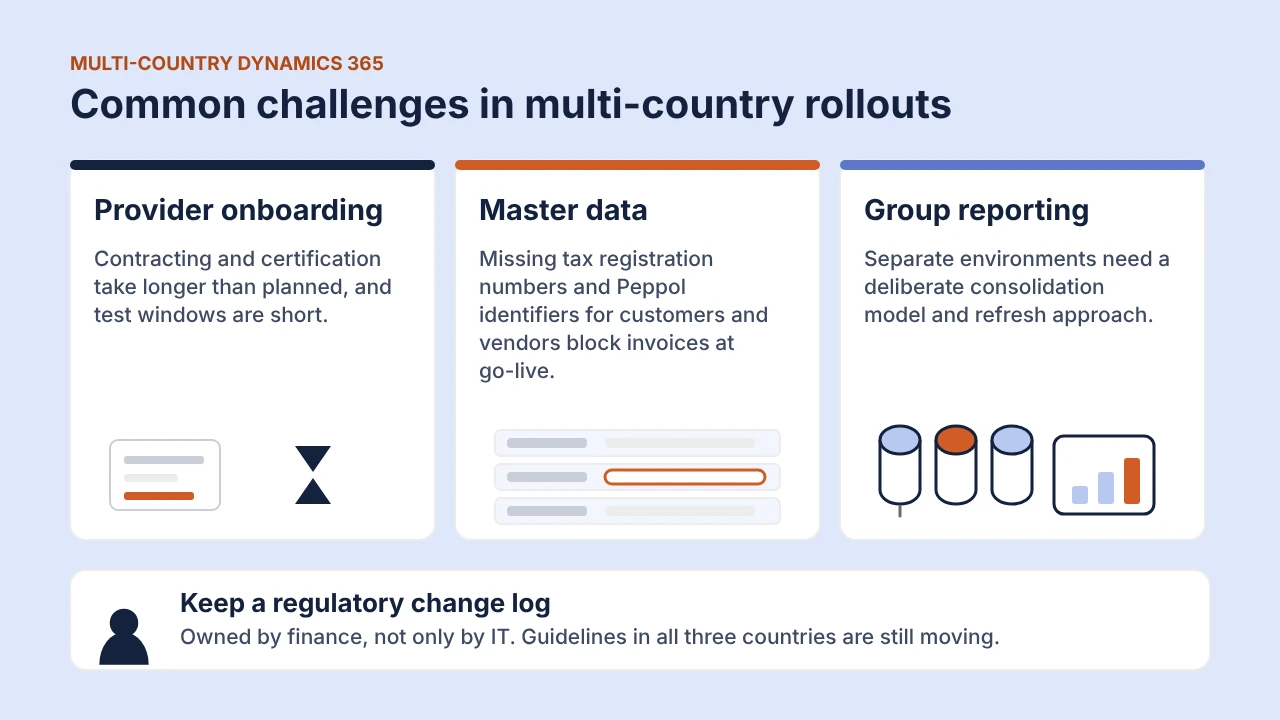
Common challenges
- Provider onboarding: contracting and certification take longer than planned, and test windows are short.
- Master data: missing tax registration numbers and Peppol identifiers for customers and vendors block invoices at go-live.
- Group reporting: separate environments need a deliberate consolidation model and refresh approach.
Because guidelines in all three countries are still moving, keep a regulatory change log owned by finance, not only by IT.
Conclusion
Sequence by regulatory clock and operational risk, not by revenue or reporting line. Settle UAE tax design early, prove the template in the first entity, use Singapore as the confirmation wave, and decide data residency before any environment is provisioned.
Dynamics Monk works across the UK, UAE and Singapore, and these are the questions worth answering before the first environment is created.